
Spekboom has become the plant equivalent of a good conscience. People buy Portulacaria afra as if the act itself settles the design argument, then plant it where a hedge is meant to perform like a wall, a wind filter, or a security screen. This leads to a succulent being bullied into formal geometry near paving, clipped into submission every few weeks, and blamed when it behaves exactly like a succulent.
Used properly, spekboom is excellent. Used lazily, it turns into a maintenance habit with a halo. The plant is hardy, easy to propagate, drought-tolerant once established, and it will take moderate frost when mature. These qualities make it a useful plant with a very specific lane, not a universal hedge.
Where spekboom actually works
Portulacaria afra earns its place in low-water gardens where an informal boundary is enough and the planting can be allowed to read as shrubs rather than a clipped wall. In sheltered inland gardens, in warmer pockets, and in mixed indigenous borders, it gives you a soft, fleshy texture that no hard-leaved hedge can copy. If you want a boundary that looks alive, loose, and a little untidy in a deliberate way, spekboom does that well.
It also suits sites where frost is not the main event. A mature plant can handle moderate frost, but a young hedge on a property that gets hard winter knocks will not behave like the old spekboom thickets in the Eastern Cape. Temperature, light, water, and pruning all change the result. A row planted in warm shelter will bulk out faster than one sitting in open Highveld exposure with cold air pooling around it.
Spekboom works because it propagates easily. Cuttings root fast, fill in quickly under the right conditions, and give you a lot of plant for not much money. For a weekend designer trying to establish a broad, forgiving edge at modest cost, that matters.
Where it does not
The trouble starts when Portulacaria afra is treated as the answer to every boundary problem. It is not naturally dense in the way a true screening hedge needs to be. Its branching is loose and somewhat brittle. The foliage is small and succulent, which gives character, but not the kind of dark, packed mass that reads as a formal hedge from a distance.
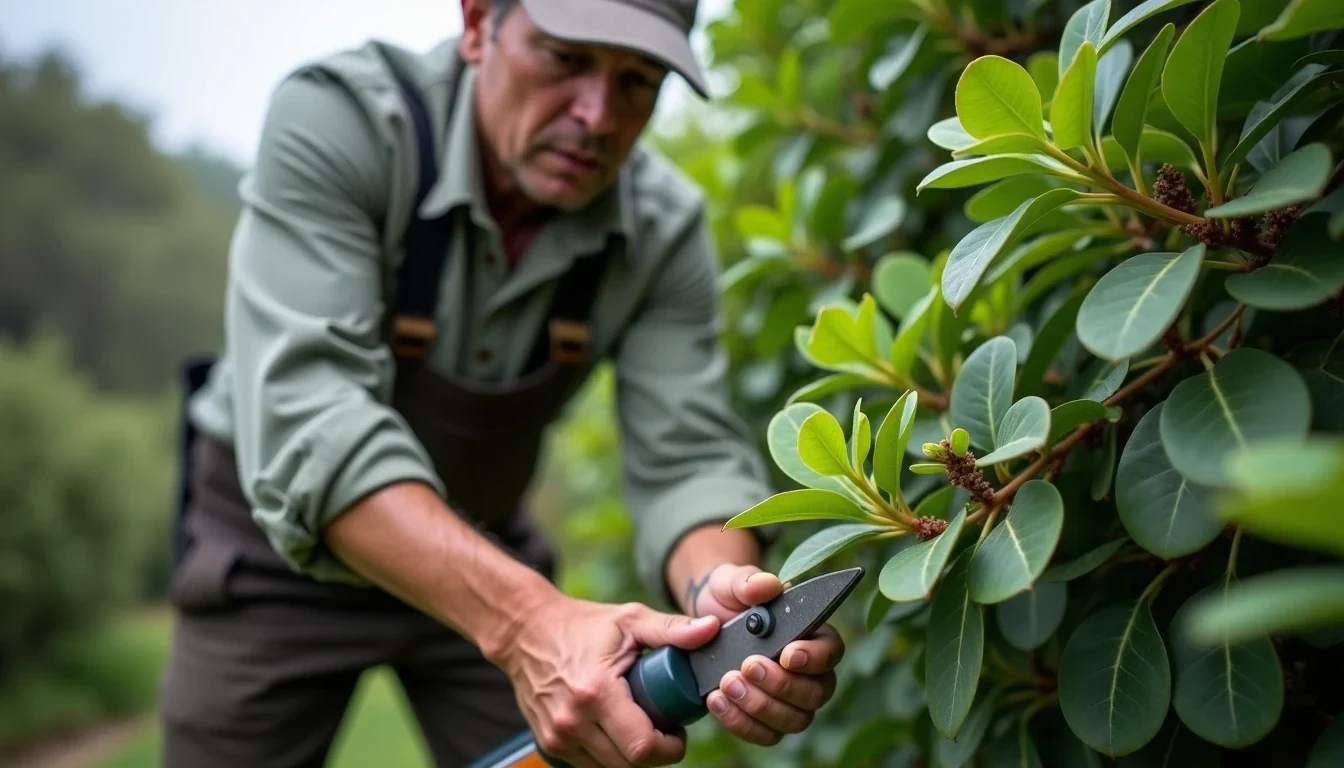
If the brief is privacy, spekboom only gives that after repeated clipping. If the brief is security, the open framework is a weakness. If the brief is wind protection, especially on a coast, it is usually not the first plant I would reach for. The plant can become a substantial shrub, even a small tree if left alone, with a mature height and spread of roughly 2 to 5 m. The common mistake is not underestimating it, but pretending it is forever small and then forcing it to live 300 mm from paving like a clipped box hedge. This leads to constant pruning, ugly cut faces, and the cursed bonsai look no one asked for.
For a hedge, plant spekboom at least 600 to 900 mm off paving or structures. It wants room to move. It also wants a design brief that accepts an informal edge rather than demanding a rigid wall.
The clipped suburban screen
If the job is a clipped suburban screen, spekboom loses to plants that are simply better at making density.
Spekboom
Portulacaria afra can be made to work, but only if you accept frequent clipping through the growing season. It suits a height of about 1.2 to 2 m if you want to keep it manageable in a domestic setting, and can certainly grow far beyond that if left untrimmed. Spread is usually similar to height over time. Plant 600 to 900 mm apart if you want the line to knit together, and keep it out of severe frost pockets. Expect pruning several times a year if you want anything resembling a formal screen.
Dodonaea viscosa var. angustifolia
Dodonaea viscosa var. angustifolia, the sand olive or hop bush, is the better choice when a client wants a neat, upright screen that still feels indigenous. It typically reaches 2 to 4 m high with a spread of 1.5 to 3 m. It takes regular clipping well, usually two to three times a year for a formal hedge. It handles moderate to severe frost once established, which makes it much more reliable on the Highveld than many gardeners expect. Plant it around 0.8 to 1 m apart. In practice, it gives more density for less fuss than spekboom.
Searsia crenata
Searsia crenata is the cleanest answer when the aim is a tight, evergreen hedge with a decent suburban polish. Expect 2 to 4 m in height and about 2 to 3 m across. It clips well, holds a shape, and settles into a dense screen with two to three prunings a year. It tolerates light to moderate frost, and it does not punish you for wanting order. If the brief is year-round privacy with less argument, this is one of the safest indigenous picks.
The coastal windbreak
Coastal planting is where spekboom looks generous on paper and awkward in the wind. Salt, blast, and shifting sandy soils are not the same as drought tolerance. A plant can be water-wise and still be the wrong tool for a coastal screen.
Dodonaea viscosa var. angustifolia
For a windbreak, Dodonaea viscosa var. angustifolia is hard to beat. It tolerates salt spray, strong wind, and sandy soil, and still keeps its composure in full sun. Plant it 0.8 to 1 m apart. Mature size runs around 2 to 4 m high and 1.5 to 3 m wide. It needs moderate pruning if you want a tidy line, but the plant itself does most of the structural work.
Searsia crenata
Searsia crenata also performs well near the sea. It gives you 2 to 4 m of height, dense foliage, and enough toughness to stand in exposed conditions without sulking. Spacing at 0.8 to 1 m creates a solid barrier. It is a better windbreak than spekboom because its architecture is already working in your favour.
Carissa macrocarpa
Carissa macrocarpa, the large num-num, is the most assertive option here. It grows to about 2 to 5 m high and 2 to 4 m wide, copes with salt and wind, and brings thorns into the conversation, which is useful if the barrier also has to discourage entry. Space plants 0.8 to 1.2 m apart. It can be clipped into a formal hedge, but it also holds a strong informal line if left a little rough.
The low-water informal boundary
As a low-water informal boundary, Portulacaria afra is genuinely strong. Once established, it needs very little supplementary irrigation in most gardens. It can sit in sun or semi-shade, which gives it more flexibility than people give it credit for. It also suits the design language of relaxed, water-wise planting far better than it suits clipped suburbia.
For this job, plant it about 0.8 to 1.5 m apart. Let it read as a substantial shrub mass rather than a forced line. Occasional shaping is enough, often once a year or less. If you are putting it into a Karoo edge, a sheltered Lowveld boundary, or a mixed indigenous garden where the fence line is allowed to look planted rather than manufactured, spekboom makes sense.
Planting distance and pruning rhythm
The most common spekboom mistake is spacing it like a clipped formal hedge and then resenting its growth. Put it 300 mm from paving and you have already lost the argument. The stems want room. The root system and branch spread need room. Denying that space makes every pruning cut part of a permanent maintenance loop.
Dodonaea viscosa var. angustifolia wants roughly 0.8 to 1 m spacing and can be clipped two to three times a year.
Searsia crenata wants roughly 0.8 to 1 m spacing and also sits comfortably on a two to three times yearly trim.
Carissa macrocarpa wants about 0.8 to 1.2 m spacing and can be maintained with similar frequency, though it tolerates a more relaxed regime if you prefer a looser line.
Spekboom wants wider spacing for an informal boundary, about 0.8 to 1.5 m, and a lighter pruning rhythm unless you are forcing a formal hedge, in which case you are signing up for repeated clipping.
What to do this weekend
Walk to an existing hedge and look at it from ground level, not from the terrace. Ask the obvious question without any plant-shop sentimentality attached. Do you need privacy, wind protection, security, or just a green boundary?
If the answer is privacy or a formal screen, reach first for Searsia crenata or Dodonaea viscosa var. angustifolia. If the answer is wind and salt, the same two still lead, with Carissa macrocarpa close behind. If the answer is a low-water, informal edge with a softer texture, spekboom finally gets the job it deserves.