
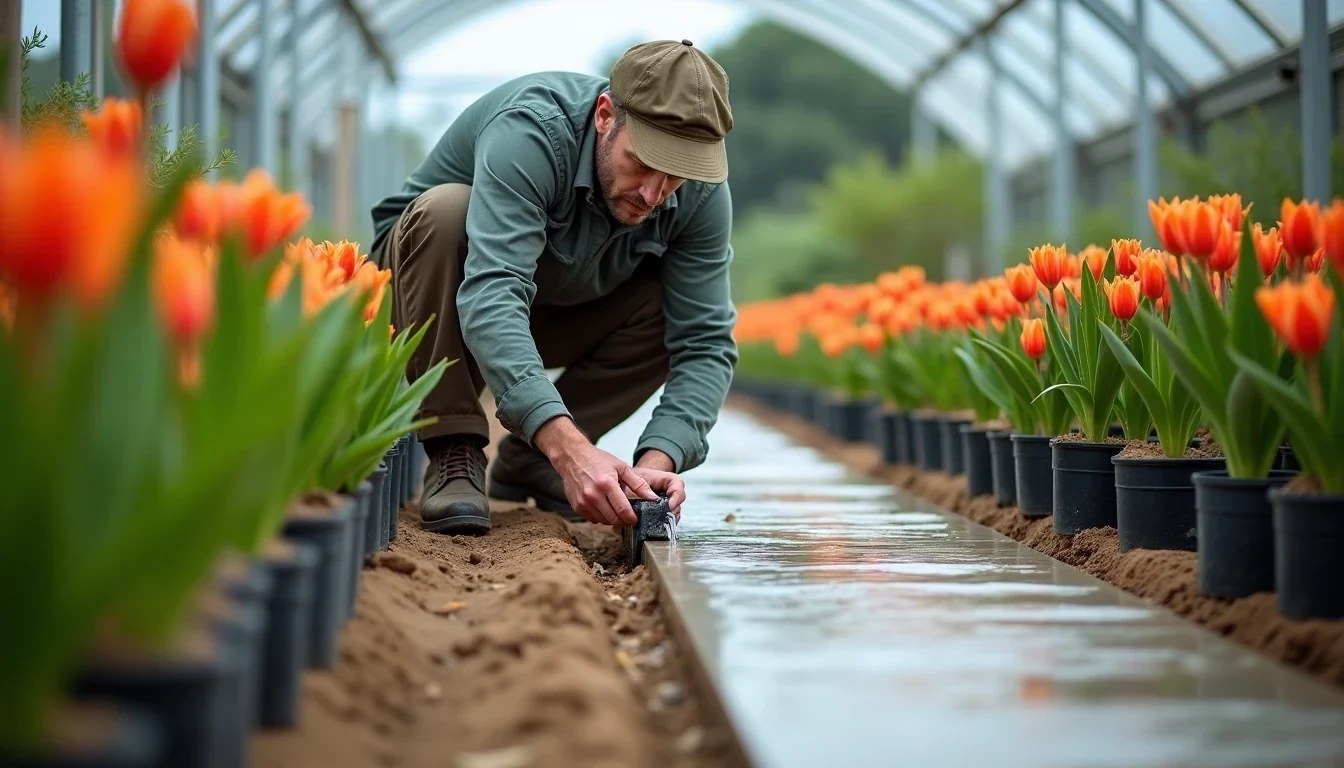
A grower in Stellenbosch once told me he cut his water bill by two-thirds after installing a closed-loop system. He then lost forty percent of his Erica crop six months later because he trusted a single UV lamp and never checked whether the water going in was clean enough to treat. This is the precise tension of runoff recycling in South African nurseries. The technology works. The savings are real. The margin between a functioning system and a distribution network for pathogens is measured in engineering details that too many operations treat as afterthoughts.
The Commercial Case Is Brutally Simple
Water tariffs in Cape Town now exceed R40 per kilolitre for high-volume users. Restrictions remain a recurring feature across the Western Cape, Gauteng, and KwaZulu-Natal. A nursery producing 10,000 Strelitzia reginae in 5L pots, irrigating at typical rates of 1-2 litres per pot daily, can burn through more than 100,000 litres in a peak month. Capture and reuse that runoff, and the arithmetic becomes obvious. Fertiliser follows the same pattern. Dissolved nitrates, phosphates, and potassium that would otherwise leach into municipal drains or neighbouring properties stay in circulation, reducing fresh nutrient inputs by roughly twenty to forty percent depending on crop type and system efficiency.
Environmental compliance is also a factor, particularly for operations near sensitive catchments or under pressure from local authorities. The real driver is operational resilience. A nursery with stored, treated water maintains production when neighbours face cutoffs. That advantage diminishes fast if the stored water carries Phytophthora cinnamomi, the organism that has devastated Protea and Fynbos plantings across the Cape Floristic Region, or Pythium species that can hollow out root systems before above-ground symptoms appear.
What Sits Between the Beds and the Pump
The gap between ambition and function starts at ground level. Runoff collection demands a minimum grade of 1:100 across growing areas, sloped toward collection points. Without this, water pools, infiltrates, or picks up debris that overwhelms downstream treatment. Impermeable surfaces are non-negotiable: concrete pads, compacted gravel with geomembrane liners, or woven polypropylene ground covers. Porous surfaces defeat the purpose, losing water to the subsoil and contaminating what remains with soil-borne organisms.
Collection infrastructure itself varies by scale. Smaller operations often use V-ditches or agricultural drainage pipe; larger sites need precast concrete U-channels sized for peak flow events including summer rainfall. The SA Weather Service data for a given location should inform these calculations, not guesswork. Channels feed sumps or sedimentation tanks where heavier particles settle by gravity. Retention time here is critical: too short, and suspended solids carry through to filtration; too long, and organic matter begins decomposing, altering water chemistry and creating anaerobic zones.
Primary filtration comes next, and the specification depends on downstream irrigation. Screen filters at 80-120 mesh suit drip systems; misting operations need 200 mesh or finer. Sand filters and disc filters handle higher loads. The purpose is not merely protecting emitters from clogging. Reducing organic load before disinfection determines whether UV, ozone, or chemical treatment actually works. A UV-C lamp at 254 nm wavelength, the standard specification for nursery applications, cannot penetrate turbidity above roughly 1 NTU. Cloudy water shields pathogens. Unfiltered runoff routinely exceeds this threshold.
Disinfection options each carry trade-offs. UV sterilisation is effective and leaves no chemical residue, but demands precise flow rates, lamp intensity monitoring, and replacement schedules. Ozonation kills aggressively but requires careful management of residual ozone, which damages plant tissue at concentrations that may still register as safe for human exposure. Chlorine dioxide and hydrogen peroxide offer chemical alternatives, though residual levels must be tracked to avoid phytotoxicity. Heat pasteurisation works for smaller volumes but scales poorly. No single method suits every operation; many successful systems combine approaches sequentially.
Storage completes the infrastructure chain. Lined ponds, above-ground JoJo tanks in 5,000L to 20,000L configurations, or custom reservoirs must be covered. Open storage invites recontamination from airborne pathogens, algal blooms that clog filters, and evaporation losses that undermine the entire water-saving rationale.
The Monitoring That Separates Function from Catastrophe
Engineering without measurement is faith, not management. Daily or weekly electrical conductivity readings using portable meters track dissolved salt accumulation. General nursery stock tolerates 0.8-1.5 mS/cm; Proteas and sensitive Fynbos varieties need lower thresholds. Exceed these, and leaf burn, stunted growth, and reduced marketability follow. The corrective action is either dilution with fresh water or a system flush, both of which carry costs that must be factored into viability calculations.
pH monitoring runs on similar frequency. Most nursery crops absorb nutrients optimally between pH 5.5 and 6.5. Deviations indicate buffering failures or chemical imbalances that affect both plant health and disinfection efficacy. Turbidity checks, whether through in-line sensors or disciplined visual inspection, determine whether UV treatment can proceed or whether filtration has failed upstream.
Laboratory analysis operates on a different rhythm. Monthly or quarterly testing for specific pathogens using PCR-based methods or traditional culturing, available through agricultural diagnostic labs across the country, catches what in-house equipment cannot. The same schedule applies to comprehensive nutrient profiling: nitrogen, phosphorus, potassium, calcium, magnesium, sulphur, and the full micronutrient suite. This data refines fertiliser programmes rather than applying blanket rates. Less frequent but targeted testing for sodium, chloride, and boron addresses the ions most likely to reach phytotoxic levels through repeated recycling.
Disinfection systems need their own verification protocols. UV lamp intensity degrades predictably and must be checked against manufacturer specifications. Chemical residuals require measurement to confirm adequate contact time without excess. These are operational disciplines, not optional extras.
Retrofitting Reality
Existing nurseries face harder choices than greenfield sites. Topographical surveys identify natural drainage patterns and low points, often revealing that optimal collection sump placement conflicts with established vehicle routes, packhouse locations, or propagation tunnels. Phased implementation helps: one block at a time, starting with highest-volume or highest-value areas. Gravity-fed collection should be prioritised where elevation allows, minimising pumping costs and energy dependence.
Compatibility with existing irrigation infrastructure is frequently underestimated. Treated water must match pressure requirements and emitter specifications. Bypass systems for maintenance or failure events are essential, with fresh water connections for emergency supply. Space allocation for filtration units, UV reactors, and buffer tanks needs to account for maintenance access and weather protection. Modularity in component selection allows expansion without complete replacement as operations grow or water costs rise further.
Counting What Counts
Capital outlays vary enormously. Concrete pads run R400-R800 per square metre. Precast collection channels cost R150-R300 per linear metre. Sand filters range from R15,000 to over R50,000; UV units from R20,000 to R100,000-plus. A 10,000-litre JoJo tank sits at R8,000-R12,000. Comprehensive systems for mid-scale operations typically land between R100,000 and R500,000, with payback periods of three to seven years depending on local water tariffs, recoverable volume, and fertiliser prices.
That calculation must include risk mitigation costs. EC and pH meters at R1,500-R5,000, regular lab testing at R500-R1,500 per comprehensive analysis, and the potential cost of crop loss if monitoring fails. A ten percent loss on a R100,000 Erica block from undetected Phytophthora contamination erodes savings fast. Some growers factor in yield improvements from optimised water and nutrient management, though these are harder to quantify prospectively.
Government grants, agricultural subsidies, or Department of Water and Sanitation initiatives may offset initial investment, though availability varies by region and funding cycle. The strategic case often transcends pure financial return. In a country where drought has shifted from exceptional to expected, water independence operates as insurance against operational interruption.
The grower in Stellenbosch rebuilt his system with proper grading, dual-stage filtration, redundant UV, and monthly pathogen testing. His water bill stayed down. His Erica survived. The difference was the engineering precision between the growing bed and the pump inlet.