

A breeder in Pretoria North can spend eight years perfecting a Pennisetum with plumes that catch the Highveld light just so, only to watch municipal bylaws reclassify the parent species and crater the market overnight. This is not a hypothetical risk. Under NEMBA’s Alien and Invasive Species Regulations, a Category 1b listing turns yesterday’s stock plant into tomorrow’s compliance headache, with fines that start at administrative pain and scale quickly. The escape route, increasingly, runs through sterility: cultivars bred to carry the visual punch without the seed set that lets ornamentals jump the garden wall and colonise watercourses, veld, and roadside ditches.
The commercial logic is straightforward once you trace who holds the risk at each stage. For breeders, a verified sterile line is a differentiated product in a market where differentiation is scarce. Ball Straathof and Starke Ayres, the two heavyweights moving young plant material across the country, already run multi-site trial networks that let them stress-test new introductions across winter-rainfall Western Cape, summer-rainfall Highveld, and subtropical KwaZulu-Natal. A breeder who can hand a grower a cultivar with documented zero germination across those zones, repeated over three flowering cycles, has something worth a premium. The label shifts from “well behaved,” a phrase that means nothing and invites scepticism, to a verified claim backed by flow cytometry and germination data.
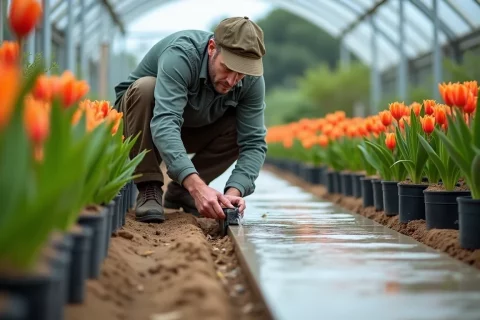
Growers gain the prosaic but no less valuable benefit of continuity. Their propagation tunnels, misting schedules, and rooted cutting protocols all stay in place. The shift from a fertile Canna line to a sterile replacement does not require retooling a greenhouse or retraining staff. What changes is the regulatory exposure. A grower holding stock of a NEMBA-listed species faces potential penalties and the reputational damage of being named in an enforcement action, particularly as municipal procurement rules tighten around invasive-free specifications.
Landscapers operate one step closer to the liability. A corporate campus or Green Star SA project that specifies Jacaranda mimosifolia for its purple spring display is gambling that the cultivar chosen will not produce the prolific viable seed that lets the species establish in disturbed veld and along watercourses. The Category 3 listing for Jacaranda already restricts new plantings in some contexts. A sterile cultivar, if one could be verified, lets the landscaper keep the aesthetic without the redesign risk that follows a bylaw change or a failed audit. The same logic applies to Lantana camara, still found in older gardens despite its Category 1b status and livestock toxicity, and to Canna indica, whose rhizomes and seeds both propagate freely in wetlands.
The gap between marketing and proof
Sterility claims are easy to print on a label and hard to defend under scrutiny. A single trial garden in Pretoria, however well maintained, tells you only what happened in one season with one soil profile and one pollinator community. Meiosis behaves differently under heat stress. Chromosome pairing in a triploid line, the standard route to sterility, can show irregularities in KwaZulu-Natal humidity that do not appear on the Highveld. A cultivar that sets no seed in its first commercial year may surprise everyone in year four when an unusual cold snap triggers viable pollen production.
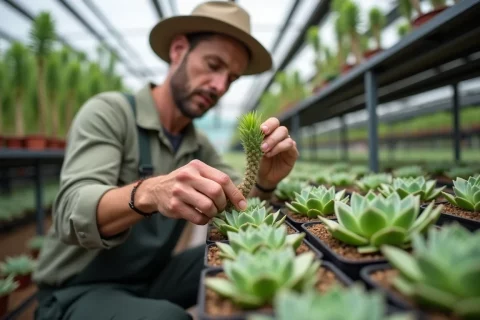
The verification protocols that separate genuine innovation from marketing fluff are not exotic. Flow cytometry measures DNA content to confirm triploidy or other ploidy manipulations. Microscopic examination of pollen mother cells catches chromosome misalignment during meiosis. Acetocarmine staining reveals whether pollen grains are structurally intact or already dead at release. Tetrazolium chloride tests on any seeds produced, however few, distinguish between empty ovules and embryos that could germinate given half a chance. Controlled hand-pollination and open-pollination in isolated plots test the worst-case scenario: what happens when compatible fertile pollen is available in abundance.
None of this is sufficient alone. The critical layer is multi-site, multi-year field exposure. A breeder working with the University of KwaZulu-Natal or Stellenbosch University can access trial stations that span the country’s climatic range. A line that shows zero germination across five sites over three flowering seasons has earned its claim. A line tested at one location for eighteen months has not. Reversion to partial fertility under environmental stress is not theoretical. It has been documented in ornamental grasses and in Salvia lines where low-seed cultivars proved less low-seed than advertised when moved to warmer, wetter conditions.
Who is doing the work
The commercial breeding pipeline in South Africa runs largely through the major young plant suppliers, but the intellectual heavy lifting often sits in university collaborations or in specialist perennial nurseries affiliated with groups like the Perennial Plant Association of South Africa. These smaller operations have been particularly active in genera where even indigenous species can become problematic outside their natural range: Agapanthus running riot in fynbos restoration sites, Dietes self-seeding into pavement cracks, Kniphofia escaping from designed plantings into grassland. Native status does not confer innocence. A plant’s behaviour depends on context, and context in horticulture means the specific cultivar, the specific site, and the specific management regime.
Ball Straathof’s network gives it an unusual capacity for distributed testing. Their involvement in sterility verification would carry weight even if the specific cultivars remain proprietary. Starke Ayres, with its historical strength in seed lines, faces the harder problem: seed sterility in a seed-propagated product is a contradiction in terms. Their route runs through vegetative propagation of selected lines or through genetic techniques that prevent embryo development while maintaining the maternal tissue that sells. Both paths exist, but neither is cheap.
The genera attracting current attention reflect known NEMBA pressure points. Buddleja species, beloved for butterfly garden plantings, seed freely into disturbed urban land. Pennisetum setaceum, the fountain grass that colonises road verges and outcompetes native grazing, is already Category 1b. Sterile alternatives would let landscapers keep the feathery inflorescence without the environmental debt. Salvia splendens, not yet formally listed but flagged by conservationists for its naturalisation potential, represents the pre-emptive case: acting before regulation forces the issue.
The cost of getting it wrong
For a breeder, the worst outcome is not a failed cross. It is a successful launch, commercial uptake, and then a reversion event that produces viable seed in a customer’s garden, documented and publicised by an alert municipal ecologist or an invasive species officer. The reputational damage extends beyond the single cultivar to the breeder’s entire low-risk portfolio. Verification is insurance against that scenario. Like most insurance, it is expensive upfront and invisible until it pays out.
Growers face a narrower but sharper risk: holding unsaleable stock when a listing changes. The 2023 amendments to NEMBA’s schedules moved several ornamentals into stricter categories with minimal transition period. A grower with ten thousand rooted cuttings of a newly listed species has options that range from bad to worse. Sterile cultivars, if verified, offer a hedge against that regulatory jump.
Landscapers pay in a different currency: redesign costs, client disputes, and the professional embarrassment of specifying a plant that must later be removed at the client’s expense. Municipal parks departments, increasingly subject to invasive species audits, are beginning to write sterile-cultivar preferences into tender documents. The specifier who can document compliance with a verified line wins the bid; the one who cannot, or who relies on a supplier’s unsupported assurance, loses it.
What to watch this weekend
The Perennial Plant Association of South Africa holds its annual open day at selected member nurseries in late October. This year’s programme includes trial bed tours where sterility in Agapanthus and Dietes lines is under informal observation. In Pretoria, the jacaranda season is peaking, and the seed pods now forming on unselected trees will ripen by late November. Collect a handful, split them, and germinate the seed on damp paper towel at room temperature. The ease with which they establish is the exact problem sterile cultivars are meant to solve. In Cape Town, the City’s invasive species unit has scheduled volunteer clearing days along the Liesbeek River, where escaped Canna indica from upstream gardens now dominates the riparian zone. The connection between garden choice and municipal labour is visible there in a way no brochure can match.