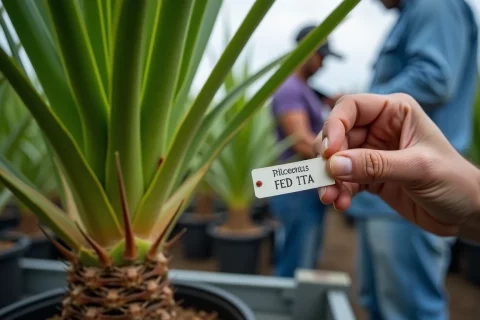

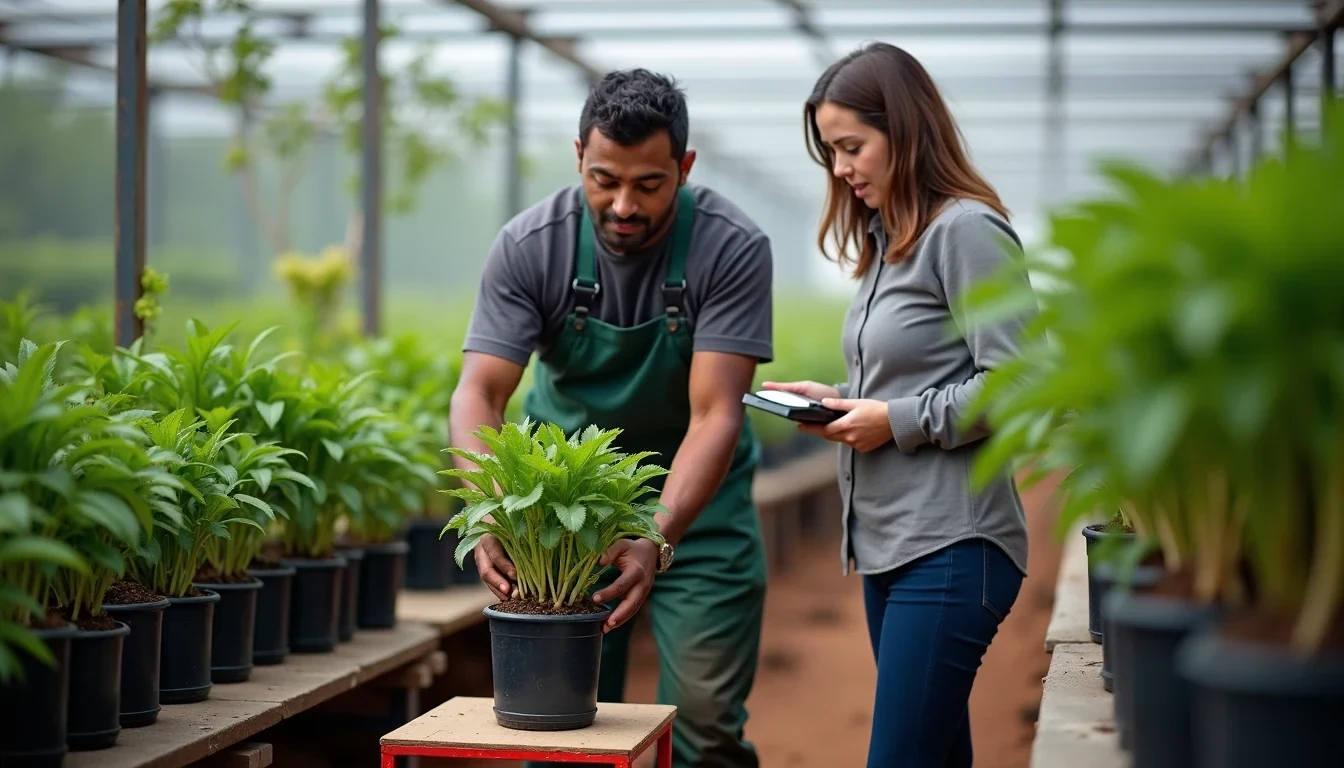
The R35-an-hour worker lifting a 5L Portulacaria afra pot onto a trolley looks like the backbone of the operation, not a cost center. Run that lift through a season, 50,000 times, and the maths turns vicious. Hortgro’s reporting on capital constraints in South African horticulture keeps pointing to the same trap: nurseries dream of robots they cannot afford while bleeding rands on movements a simple conveyor could eliminate.
The movement nobody counts
Most ornamental nurseries already know their wage bill. Fewer know what a single repeated motion costs them across sixteen weeks of spring and summer. A propagation manager in Pretoria East might track litres of water per thousand cuttings, or germination rates to the decimal. The same manager often guesses at how many hours staff spend carrying trays from tunnel to hardening bed. Guessing is expensive.
Time-motion studies strip away the guesswork. Watch a worker fill 100 5L pots by hand, timing each scoop, each tamp, each transfer to the trolley. Multiply by the season’s volume. At R35 per hour plus the 25 percent loaded cost for UIF, SDL and COIDA contributions, a potting run that consumes four hours daily for twelve weeks hits roughly R50,400 in direct labour alone. That is one task, one worker, one cultivar. A nursery running Strelitzia reginae, Dietes grandiflora and Buddleja saligna through the same tunnel has fifteen such movements.
The injury ledger completes the picture. COIDA claims for repetitive strain injuries, lower back strains, and carpal tunnel syndrome cluster around the same jobs: tray filling, pot spacing, hand-watering checks, the endless lift-and-carry of maturing stock. Each claim carries a direct medical cost, lost productivity, temporary labour replacement, and administrative drag. A single back strain claim can absorb the equivalent of three seasons’ wages for one worker. Nurseries that do not link their incident logs to specific tasks miss the pattern. The movement that costs R50,000 in labour often costs another R20,000 in risk, spread across the years until the injury lands.
Why the robot stays in the brochure
European trade shows display robotic arms that graft, sort, and place pots with sub-millimetre precision. South African nursery owners return from these shows with glossy brochures and a familiar headache. A robotic grafting cell runs between R500,000 and R5 million, depending on throughput and software integration. That capital outlay assumes months of site preparation, imported technicians for calibration, and ongoing specialist maintenance that local service networks may not support.
Hortgro’s consistent finding on mechanisation barriers points to capital constraint as the binding one. A nursery that cannot raise R500,000 for a robot without threatening its cash flow is being realistic, not conservative. The question is not whether robotics work; it is whether the payback period outlives the nursery.
Smaller mechanical interventions invert the calculation. A modular belt conveyor, sized for a potting line, runs between R30,000 and R100,000. A semi-automatic potting machine with a soil hopper and pot dispenser lands in the R50,000 to R150,000 range, depending on throughput. These are operational decisions with payback horizons measured in months, not years. They are not aspirational purchases.
The conveyor that paid for itself by spring
Consider a nursery in the KwaZulu-Natal Midlands propagating Strelitzia nicolai in 20L bags. Staff were carrying filled bags from the mixing bay to the standing area, roughly forty metres, across uneven gravel. Two workers, four hours daily, twelve weeks. The loaded labour cost approached R25,000 per season. The carrying motion generated three lower back incidents across two years, one of which became a COIDA claim with six weeks of lost productivity.
A fixed roller conveyor, installed at waist height with a slight downward pitch, cost R45,000 including local steel fabrication. It eliminated the carry entirely. Bags roll from mixer to standing area in under thirty seconds. The payback on labour alone was under two seasons. The injury risk for that task reduced to near zero. The workers, freed from carrying, were redeployed to grading and quality control, tasks that improve sellable stock rather than simply moving it.
This intervention pattern repeats. A vacuum seeder for Erica species, at R15,000 to R40,000, replaces the hand-sowing that strains eyes and wrists across hundreds of trays. An ergonomic trolley redesign, R5,000 to R20,000 per unit, eliminates the bent-back lift of heavy specimens. Automated irrigation controllers, from R10,000, remove the repetitive trudge of hand-watering checks. None of these technologies impress at trade shows or require a software specialist. Each addresses one bottleneck precisely.
How to find your own costly motion
The methodology is straightforward and rarely implemented. Select the task that generates complaints, queues, or incident reports. Time ten repetitions with a stopwatch, average them, and multiply by the season’s volume. Apply the loaded wage rate. Check the incident logs for the past three years, calculate the probability of injury per thousand repetitions, and apply the average claim cost. The sum is the true rand cost of that movement.
Frontline staff know the answer before management does. The worker who fills pots until her wrists ache, who knows exactly which trolley has the sticky wheel that forces an awkward twist, who can predict which humid Thursday in November the back strains will start—she is the data source. Anonymous surveys or direct interviews capture what time studies miss: the subjective cost of fatigue, the micro-adjustments that slow production before they cause injury.
The correct technology, once the cost is known, is the smallest intervention that removes the bottleneck. Not the most advanced or the most visible, but the smallest. A conveyor where carrying hurts. A potting aid where scooping exhausts. A trolley where lifting injures. The discipline is in matching the intervention to the measured problem, rather than purchasing aspiration and hoping it fits.
What to do this weekend
Walk your own operation with a stopwatch and a notepad. Pick the three tasks your staff complain about most, or where you notice queues forming. Time twenty repetitions of each. Ask your longest-serving worker which motion she would eliminate if she could. That conversation costs nothing. The conveyor, potting aid, or trolley redesign that follows might cost R30,000. The movement it eliminates, measured across the season, probably costs more and keeps costing until something changes.