
Palm bud rot exposes lazy habits. The 2025 detection of Phytophthora palmivora in South Africa not only identified a disease, it also revealed which nurseries ran proper plant trials and which relied on memory, invoice folders, and a vague sense of where palms went.
This is a dangerous situation when a water mould is involved. Phytophthora palmivora travels in soil, on roots, and in infected plant material. Once it infects a palm, the spear can collapse, the crown can fail, and the entire plant can die. A nursery that cannot identify the exact batch that left the yard, who bought it, and where it was delivered is not keeping records; it is keeping receipts.
Paperwork that stops at the till is not enough
Most nursery records are designed for financial transactions, not plant movement. They confirm that plants were sold and cash was received. They do not specify which palms came from which supplier load, which tray they occupied, which bakkie transported them, or which landscaper took them to a site in Pretoria East, Midrand, or George.
This is acceptable until a pathogen appears and the Department of Agriculture discusses host material from affected areas and movement controls to prevent the problem from spreading to unaffected provinces. Then, a statement like “we sold quite a few around Gauteng” is useless. It does not help an inspector, a customer, or the nursery when the phone starts ringing.
The old style of record keeping treats a sale as a financial event. The new style treats it as a biological event. Nurseries must make this shift to remain viable after an outbreak.
A batch trail turns a palm into traceable stock
The simplest solution is also the one many nurseries avoid because it seems like extra administration. Assign every incoming or in-house propagated palm batch a unique code, and then carry that code through the entire chain.
If a load of Phoenix canariensis arrives from a supplier, log the supplier name, date, quantity, and original batch code. If the nursery propagates or holds its own stock, create a unique code that can withstand a busy season and tired staff. A code such as PC2025-03-A is boring, which is perfect because boring is searchable.
That code then needs to appear in the places that matter:
- on the batch label attached to the pots or trays
- on the delivery note
- on the sales invoice
- in the customer record
- in the supplier file if the stock came in from outside
This is how a nursery identifies every customer who received palms from an affected batch. It is not done by guessing or by asking who remembers. It is done by matching the outgoing code to the buyer, the delivery date, and the destination.
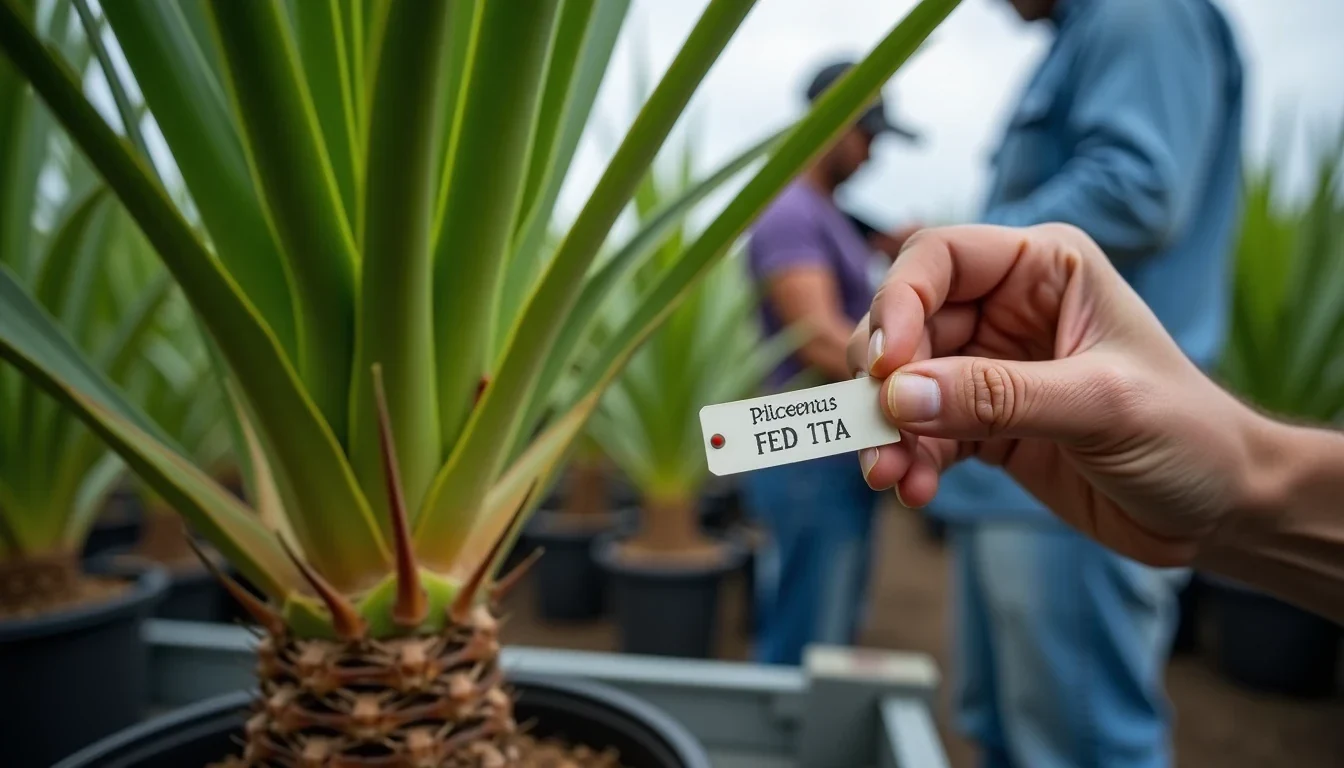
A label on a palm is not decoration. It is a field note attached to a living plant.
Movement controls only work when the nursery can answer fast
The department’s response to the 2025 detection focused on restricting host material from affected areas to prevent the disease from spreading to untouched provinces. This strategy only works if nurseries can map their own movements with enough precision to cooperate quickly.
Because the pathogen can reside in soil, roots, and infected material, the chain extends beyond the plant itself. A potting mix spill, a reused tray, a contaminated trolley, a mixed load on the back of a delivery truck—all become part of the story. Nurseries and landscape contractors are not side characters in that story; they are the transport network.
A proper trace allows a nursery to do three things immediately.
First, it can isolate the remaining stock from the suspect batch.
Second, it can call the customers who received those palms and give them exact instructions instead of broad panic.
Third, it can show officials what moved, when it moved, and where it landed.
The last part is important because the cleanest response draws the smallest circle around the problem. Broad uncertainty leads to broad restrictions. Precise records keep the circle tight.
Customer confidence depends on specific answers
When a disease event occurs, customers do not want a speech about general hygiene. They want to know whether the plants in their garden, estate, or roadside job are part of the affected line. If a nursery can answer that question clearly, trust holds. If it cannot, every buyer starts assuming the worst.
Delivery notes become more than office paper. A good delivery note is a memory the nursery can trust after the staff who packed the truck have moved on to other jobs. A supplier record does the same thing from the other side of the yard. Combine the two with batch labels, and you get a trail that survives staff turnover, busy seasons, and a disease scare.
This is also where the trade splits into two camps. One group can state exactly which palms went to which clients and which site they landed on. The other group can only offer an estimate and a shrug. In a normal week, that difference looks like admin style. In an outbreak, it becomes reputation.
The weekend job list
Nurseries do not need a software overhaul to get this right. They need discipline and a system that staff will actually use.
- Assign a batch code to every palm lot on arrival or propagation.
- Print that code on a durable label and keep it attached until the stock leaves.
- Add the batch code to every invoice and delivery note.
- Record customer name, site address, date, species, quantity, and batch code together.
- Keep supplier batch details alongside your own internal code.
- Separate lots physically so one suspect batch does not blur into the next.
- Train drivers and yard staff to check labels before stock goes out.
- Reconcile the books against the plant trail, not the other way around.
Do that, and the nursery has more than a paper trail. It has a containment tool.
Palm bud rot will not be the last disease to test the trade, nor will it be the last time movement records decide who navigates the mess and who gets caught guessing. The nurseries that survive this round will be the ones that can tell the story of every palm they sold, from supplier bench to customer gate, without resorting to a shrug.