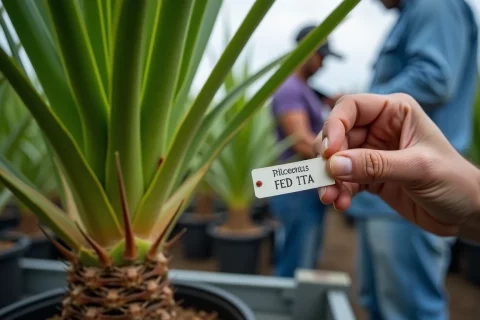


A ‘Protea cynaroides’ arrives at a nursery in Somerset West with a plastic stick tag that reads “King Protea, full sun, moderate water.” The landscaper who buys it knows this is barely a beginning. That cultivar might be ‘Madiba,’ bred for cut-flower production with a specific response to pruning, or a garden selection with different vigour. The tag cannot say. It never has been able to say. The plant dies in heavy clay with summer irrigation, or thrives in conditions its breeder never intended, and nobody downstream learns which version of the story they were holding.
The gap between what a physical tag can carry and what a plant actually needs has been obvious for decades. The technology to close it now costs almost nothing. A QR code printed on a label costs fractions of a cent. The database behind it is a solved problem. The real work and cost is deciding who owns the truth about a plant and keeping that truth alive as the plant moves through hands.
What the breeder knows and the tag cannot hold
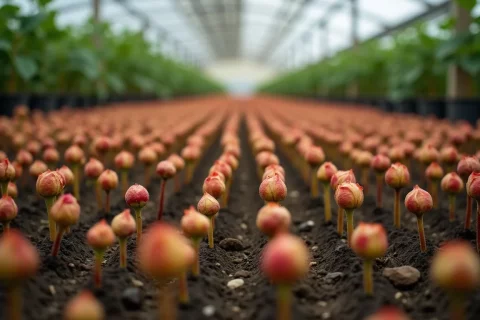
The breeder of a new Leucadendron hybrid holds information no retail tag has ever accommodated. Parentage records, crossing dates, performance data from trial plots in Elgin and Nelspruit, specific resistance or susceptibility to Phytophthora cinnamomi, the rooting hormone concentration that gave acceptable strike rates in propagation. This is the foundation layer of any serious digital passport, and it is currently trapped in spreadsheets, field notebooks, or the memory of the breeder themselves.
Plant Breeders’ Rights registration adds another stratum. A PBR-protected cultivar carries legal identity for royalty collection and enforcement. The breeder needs to know which plants were sold under licence, where, and in what quantities. A digital record that followed the plant could automate much of this tracking. It would replace the current system of paper certificates and trust-based reporting that leaves breeders guessing at actual propagation volumes.
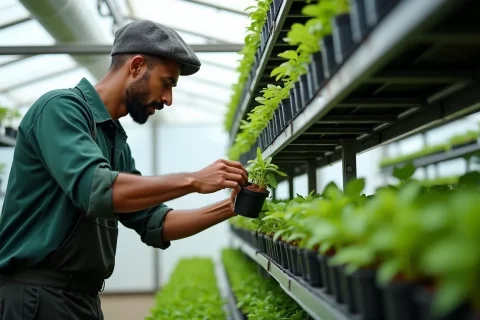
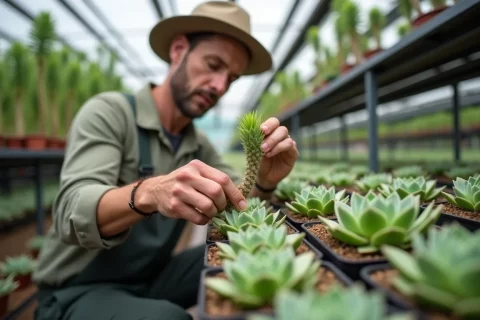
The propagator who takes cuttings from the breeder’s stock needs different detail again. Batch identifiers, treatment dates, environmental parameters during rooting, hardening-off schedules. A propagation house in Caledon might achieve 80 percent strike rate with one protocol and 45 percent with another. This difference is commercially decisive. Currently this knowledge rarely travels with the plant. It stays in the propagator’s records, if it is recorded at all.
The grower’s daily accumulation
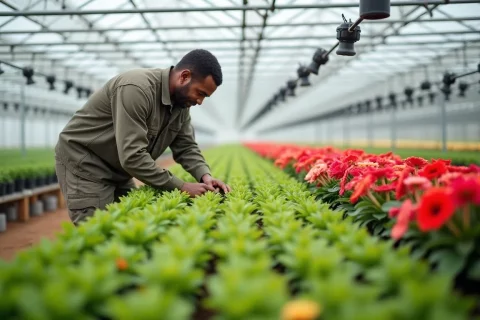
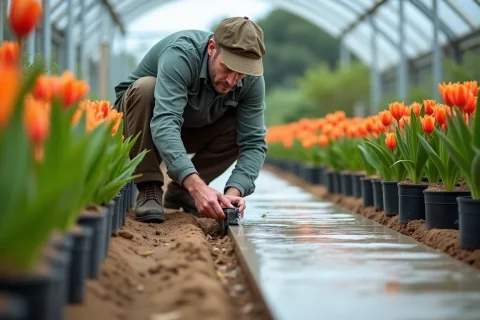
By the time a plant reaches a commercial grower, the digital passport should be accumulating operational intelligence at speed. Fertiliser regimes, irrigation scheduling, growth regulator applications, pest scouting reports with dates and products used. A grower in the Boland managing Proteaceae knows that a batch treated for scale in October carries different residue profile and withholding period implications than one treated in February. This is not abstract compliance data. It determines whether a plant can be dispatched to a retailer with food safety certification requirements, or whether it must be held.
The grower also holds the first practical knowledge of how a cultivar performs at scale. The breeder’s trial data might show excellent vigour in a half-hectare plot. The grower discovers that at ten thousand units, the same cultivar shows unexplained variability in flower timing, making it unsuitable for Mother’s Day supply contracts. This observation, recorded against the batch, becomes intelligence the next grower, or the breeder considering a second generation, desperately needs.
Current practice fragments this accumulation. Batch cards get lost. Excel files sit on one computer and disappear when the horticulturist retires. The institutional knowledge that the research pack identifies as a major current repository is precisely what a digital passport should make transferable and permanent.
The retailer’s narrow window
A retailer like Stodels or Lifestyle Home Garden faces the compressed challenge of converting all this accumulated intelligence into a customer interaction measured in seconds. The shopper standing in the aisle with a phone in hand represents both opportunity and risk. Scan a QR code and receive a two-minute video on planting depth and drainage for this specific Protea cultivar, and the sale converts with confidence. Scan and receive a generic care page that mentions “moderate water,” and the customer either ignores it or follows advice that kills the plant within six weeks.
The retail layer of a digital passport needs to be ruthlessly practical. Mature dimensions accurate for local conditions, not the breeder’s catalogue figures from a different climate zone. Companion planting suggestions that account for what is actually available in the store. Links to the specific acidic potting mix formulated for Proteaceae, not a generic “suitable compost” description. Retailers who have experimented with QR-linked content report reduced returns and fewer staff hours spent on basic care queries. The benefit is measurable in rand and in customer retention.
The risk is the opposite trajectory. A QR code that links to a dead URL, or to content last updated three seasons ago, damages trust more than a plain plastic tag ever could. The technology is simple. The maintenance commitment is not.
The landscaper’s site reality
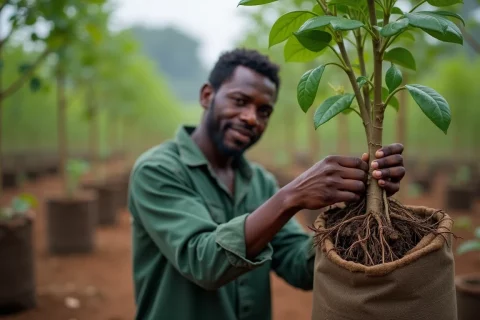
For the landscaper installing a plant, the digital passport must answer questions the breeder never considered and the grower could not predict. How does this cultivar perform in the specific frost pocket of a Ceres valley site versus the frost-free coastal conditions of Durban? What is the actual root system architecture, and how does it interact with paving or drainage infrastructure? What pruning regime maintains the density required for a hedge without sacrificing the flowering that justifies the plant’s selection?
A landscaper working on a commercial installation in Johannesburg needs to know whether a plant tagged as “frost hardy” survived the 2019 cold snap in Benoni or only in the urban heat island. Generic hardiness zones do not answer this. Specific performance data, geotagged and dated, would. The digital passport could accumulate this as landscapers contributed observations back to the central record, creating a feedback loop that improved the database over time. Currently this loop barely exists. Landscapers learn, forget, move on, and the next installer starts from the same generic advice.
The trust architecture behind the code
The technical implementation of QR-linked plant records is genuinely straightforward. Generate a unique identifier, encode it, link to a database entry, print. The hardware and software are commodities. Establishing the organisational and commercial framework that keeps the data accurate, accessible, and appropriately controlled is not straightforward.
South African horticulture lacks any unified data standard for plant records. Breeders use their own nomenclature. Growers track in spreadsheets with incompatible structures. Retailers maintain product databases that do not talk to supplier systems. A digital passport that worked across this landscape would require either industry-wide agreement on format and protocol, or a platform successful enough to become the de facto standard through adoption.
Data ownership raises further complications. The breeder’s genetic and propagation data is commercially sensitive intellectual property. The grower’s cultivation records contain competitive information about costs and suppliers. The retailer owns the customer relationship. A landscaper contributing site performance observations might reasonably claim some stake in the resulting intelligence. A single trusted record requires legal and commercial architecture that does not yet exist, and smaller operators may lack resources to engage with it.
Connectivity and digital literacy vary sharply across the industry’s geography. A breeder in Stellenbosch with fibre access and a dedicated IT function faces different constraints from a specialist grower in the Eastern Cape relying on intermittent mobile data. Any system that assumes consistent online access will exclude participants and fragment the record.
What generic advice actually costs
The consequences of failing this challenge are visible in every retailer’s returns bin and every dead planting in a landscape installation. A Protea killed by overwatering in summer represents direct financial loss to the customer, reputational damage to the retailer, and a missed opportunity for the breeder whose cultivar never performed to potential. Multiply this across thousands of plants and the cost of generic, outdated, or untraceable information becomes substantial.
For the industry specifically, the inability to trace plant provenance complicates pest and disease response. An outbreak of a regulated pest in a production area requires rapid identification of which plants left that area and where they went. Batch tracking that stops at the nursery gate is inadequate for this. A digital passport that followed plants through the supply chain would enable targeted notification and containment, reducing both spread and the economic damage of blanket restrictions.
Enforcement of Plant Breeders’ Rights similarly depends on traceability. A breeder who suspects unlicensed propagation currently faces the near-impossible task of proving provenance without records that follow the plant. A digital passport would not eliminate infringement, but it would make detection and prosecution more feasible, strengthening the commercial basis for breeding investment.
The harder problem worth solving
The temptation with any new technology is to implement the easy part and declare victory. QR codes on tags, linking to basic care pages, are already appearing in South African retail. This is not the digital passport described here. It is a modest improvement on the plastic stick, and it will fail in the same ways when the care page is generic, the link breaks, or the plant’s specific history matters more than any static advice can convey.
The harder problem is maintaining one living record that accumulates truth about a plant as it moves, serves each participant’s specific needs without overwhelming them, and remains accurate and accessible over time. This requires sustained investment in data infrastructure, industry coordination that does not yet exist, and a shift from thinking of plant information as a marketing add-on to treating it as operational infrastructure.
The breeder who knows exactly how a cultivar roots, the grower who has managed its pest profile, the retailer who can connect a customer to specific success, the landscaper who feeds back site performance, all contribute to a record that makes the next decision better. The technology to enable this is ready. The organisational will to build and maintain it is the remaining variable.