

The Plant Improvement Act has ended the old nursery habit of keeping the plant, the label, and the paperwork in three different places, hoping nobody asks awkward questions. From 1 December 2025, Act 11 of 2018 replaces the 1976 law that governed the sector for decades. The new regime reaches straight into parts of the business ornamental growers usually treat as internal housekeeping.
If you run an ornamental nursery, a young-plant operation, or a propagation unit, the message is blunt. Registration, variety identity, supplier records, plant quality, and labelling now belong in one system, not in separate files that only come together when an inspector is on the gate. Growers who treat this as paperwork will feel squeezed. Those who treat it as traceability will have something buyers can actually trust.
The nursery is now the unit the law looks at
The new Act cares about the business behind the plant on the bench and the premises where the work happens. The Department of Agriculture, Land Reform and Rural Development wants a register that shows who is producing, propagating, processing, or selling regulated plant material, and where that activity takes place.
For a nursery with one block in Paarl and another propagation site somewhere else, this matters immediately. The address on the invoice is no longer enough. If the business is split across sites, each relevant premises needs to be visible in the compliance picture. A grower moving rooted cuttings between a tunnel farm, a potting shed, and a sales yard cannot treat those spaces as one blur anymore.
The law also brings imports and exports into the same frame. Stock that arrives from outside the country, and material that leaves it, now sits inside a tighter control system. This matters for the ornamental trade because much interesting material begins life as imported cuttings, tissue culture, or breeding lines that must be tracked before they ever become shelf stock.
Variety names now need proof behind them
The sector has long survived on informal naming, shorthand labels, and the occasional hopeful guess. The new Act pushes against this casualness. It introduces national variety listing, certification schemes, and quality standards for plants and propagating material intended for sale. The name on the label has to mean something, and the plant behind it has to earn that name.
A tray sold as `Pelargonium` without a proper cultivar identity is one thing. A tray sold as a named line, when the stock is really something else, is another. The same goes for `Protea`, `Strelitzia`, `Agapanthus`, and the rest of the ornamental mix. Buyers paying for a named variety are paying for performance, flower form, timing, vigour, and consistency. If the nursery cannot stand behind the identity, the label is just decoration.
The quality side is just as sharp. Propagating material now has to meet prescribed standards, which puts pressure on everything from disease status to uniformity. A batch that looks fine on the day of dispatch can still be a problem if the source is messy, the mother stock is weak, or the line has been passed around the industry with no real control. The old habit of trusting a familiar supplier and calling that due diligence is on borrowed time.
Certification schemes may become the easiest way for serious growers to prove they are not guessing. A scheme backed by records, inspections, and agreed standards gives a buyer something firmer than a promise. For high-value ornamentals, that can become the difference between being one of ten suppliers and being the supplier a landscaper or retailer keeps going back to.
The records have to tell one story
This is where the compliance burden either turns into a real business system or collapses into chaos. The Act pushes nurseries toward a complete trail from incoming material to outgoing sale. Supplier records, batch numbers, quantity received, date received, variety name, health status, and the supplier’s registration details all need to line up. Once material is inside the nursery, the internal movement of that stock needs to stay visible too.
A nursery buying Petunia cuttings from a young-plant grower cannot leave those cuttings to disappear into a general bench label and a sales spreadsheet. The incoming batch should keep its identity through potting, pinching, spacing, spraying, and dispatch. If a spray round hits one batch and not another, the records should show that. If a line is split for a retailer order and a landscaper order, the split should be traceable. If the stock is sold to a garden centre in Gauteng and a contractor in the Cape later asks where it came from, the answer should not depend on who was on duty that day.
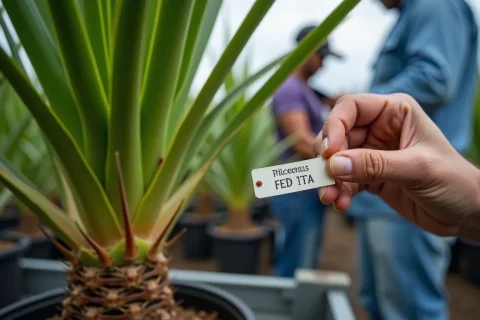
Labelling has to do more than look neat. It needs to connect the plant to the business, the batch, and the identity behind the batch. A label that says the right cultivar name but nothing else is already too thin for the new world. Digital systems, QR codes, and barcode tags are not the point of the law, but they make sense once the nursery stops pretending that memory is a record system.
Staff training is part of the same job. The propagator, the packhouse team, and the person printing labels all have to work from the same rules. If one person writes the mother stock code one way and another person writes it another way, the trail breaks. This is how nurseries get caught with perfectly healthy plants and hopelessly unusable records.
The growers who win will make compliance visible
A commercial edge hides inside all this admin. Buyers already know the difference between a nursery that can talk and a nursery that can prove. The new Act rewards the second one.
A traceability system turns compliance into a selling point. It lets a grower show where the material came from, how it moved, what it was treated with, and which batch ended up with which customer. That builds trust with landscapers, retailers, and bigger wholesale buyers who do not want to discover a naming mistake or disease issue after the trucks have left. It also helps when something goes wrong. A precise batch trail makes recalls faster and limits the damage.
That sort of visibility can justify better pricing too. People will pay more for stock that is clearly identified, properly handled, and backed by records that make sense. They will also come back more quickly when the first order arrives exactly as promised. In a trade where too many plants still travel on reputation alone, being able to prove the story behind the tray is a real advantage.
What to do this weekend
- Map every site where regulated plant material is produced, held, or sold.
- Make a single list of all supplier names, registration details, and batch references.
- Check whether every cultivar or line you sell has a clean, consistent identity on the label and in the ledger.
- Review how incoming stock moves through propagation, potting, holding, and dispatch.
- Tighten your labels so they connect to the batch record, not just the shelf name.
- Put one person in charge of the compliance trail, then train the rest of the team to feed it properly.
- Ask your best customers what proof they would want if they were buying your plants at scale, then build for that standard.